Sikkim feels like a quiet exhale after the rest of India — mountains instead of noise, monasteries instead of traffic. It’s quiet, its peaceful, it has red pandas.
It doesn’t try to overwhelm you; it just stands there and lets you adjust to the altitude — physically and otherwise.
First things first: drive up a ridiculously long winding road guaranteed to make anyone feel carsick.
Lucky for me the roads were so creepy and steep that I completely forgot how horrible I was feeling!
Not to mention the Indian obsession with overtaking people.
Alright the anti-sick pills may have helped.
A lot.
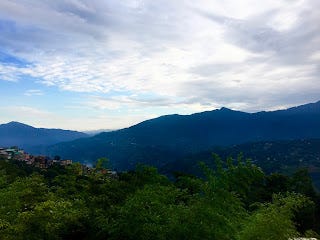
We arrived in Gangtok about five hours later to this:
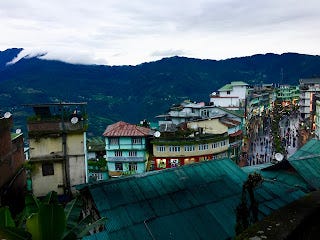
Gangtok, the capital of Sikkim, sits at about 1,650m above sea level in the eastern Himalayas. It used to be an important stop on the old trade route between Tibet and India before Sikkim officially became the 22nd state of India in 1975 — which means it hasn’t actually been part of India for that long in historical terms.
When traveling in this area, make sure to communicate well with your front desk.
Next day we get a wonderful wake up call at 7am.
Because we only needed to wake up at 8am.
Because we were only leaving at 10am.
Make it make sense.
7. AM.
We visited monasteries:
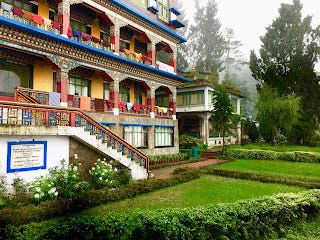
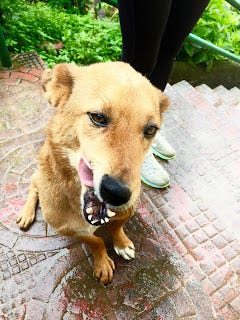
And dogs.
And football! Who knew Sikkim was so into football?
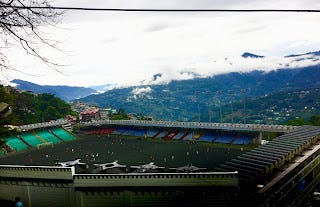
Now this is how you’re supposed to play.
I need this view.
Gangtok is dotted with Tibetan Buddhist monasteries thanks to its strong Nepali and Tibetan influences — the most famous being Rumtek Monastery just outside the city, one of the most important centres of the Karma Kagyu lineage outside Tibet. Prayer flags everywhere. Mountain backdrops everywhere. Zero complaints (apart from the early wake-up call).
Also when you are in this region make sure you eat carefully.
I ate momos (Indian dumplings).
And that was the last time I ate momos.
Yup. You guessed it.
I got……… food poisoning!
And it was absolutely horrible! We’re talking vomit, we’re talking the other stuff, we’re talking endless waves of pain!
So. A day later. When I finally could. We ate a lot of bread. And bananas.
There are few things better than butter and bread.
At least the view was nice.
Note to self: I may be Indian, but my stomach is not.
The next day we drove to Namchi where we saw the tea plantations, a gigantic Buddha and a gigantic Shiva (who isn’t a woman?! Who knew? Actually everyone probably knew that. But it’s fine.)
Tea.
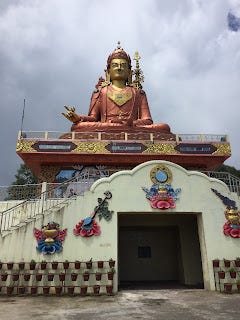
Gigantic Buddha.
Gigantic Shiva.
After Namchi we went to Pelling which is located at about 2500m above sea-level.
So. We arrive at the hotel and we can’t find anyone. Turns out the receptionist fell asleep on the sofa, nicely hidden from view.
We check in and go to our room.
No wi-fi, no English language TV.
What were we going to do with our lives.
Sleep. We slept. A lot. Kind of.
We woke up to the lovely sounds of a cow moo-ing at 6 in the morning.
6. AM.
But hey. We also woke up to this:
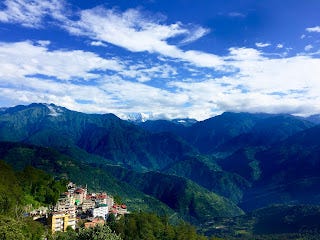
This is the Kanchenjunga mountain range, the mountain itself is the third highest in the world. Behind it is Nepal.
Oh I forgot to mention that we were landlocked between China, Nepal and Bhutan for the duration of our stay. Which means that if we could actually eat we’d have been able to eat really good Chinese food.
But. Again.
Stomach =/= Indian.
While in Pelling we saw this, this and this:
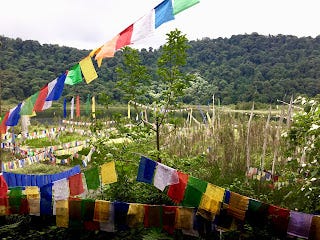
It’s safe to say we had amazing views all around.
We had a fairly interesting trip.
Whatever mountain range I visit next, it will have a lot to live up to. Even with its (fine my) dietary struggles, it was a trip not easily forgotten.
